
“Verification Pending” is the status most MPTAAS applicants see for the longest time, and the one that causes the most worry. The application has been submitted, nothing looks wrong, and yet the status does not change. This article explains, in principle, why an application stays pending, where it is waiting, and what a student can check. It gives no portal steps, no per-stage timing and no correction procedure as fact. Verification happens in stages, and the stages are described here only as secondary sources agree on them — the official portal has not loaded in any of our live checks, no official student manual defines the stages, and no timeline for 2026-27 has been announced.
Source status — checked 22 November 2026
What is verified: the MPTAAS cycle runs through verification stages in principle — institute first, then the district or divisional authority, then sanction — as described in our timeline and status-meanings articles. What is NOT verified: how long verification takes at any stage, what the portal shows at each stage, and what a student must do to move an application forward. The official portal https://www.tribal.mp.gov.in/MPTAAS did not load in our live check this morning (timed out twice, 07:33–07:49 PKT, 22 November 2026). Secondary sources agree on the institute-then-district order but conflict on timelines — “during the application window”, October to February, 15–30 days — and none of them cites an official notice. This article states NO timeline as fact.
Why verification exists at all
A scholarship application is a claim: that the student is enrolled, belongs to an eligible category, and meets the scheme’s conditions. Before money is released, somebody has to check that claim against records. That checking is verification, and it is done in stages because no single office holds all the records. The institute holds the admission and attendance records. The district or divisional authority holds the administrative check. The department gives the final approval. An application is “pending” while it is waiting for one of those offices to complete its check — not because it has failed, but because it has not yet been reached.
Institute pending vs district pending — the two places an application waits
Secondary sources agree on the order, and the distinction matters because the student can only usefully act at the first stage.
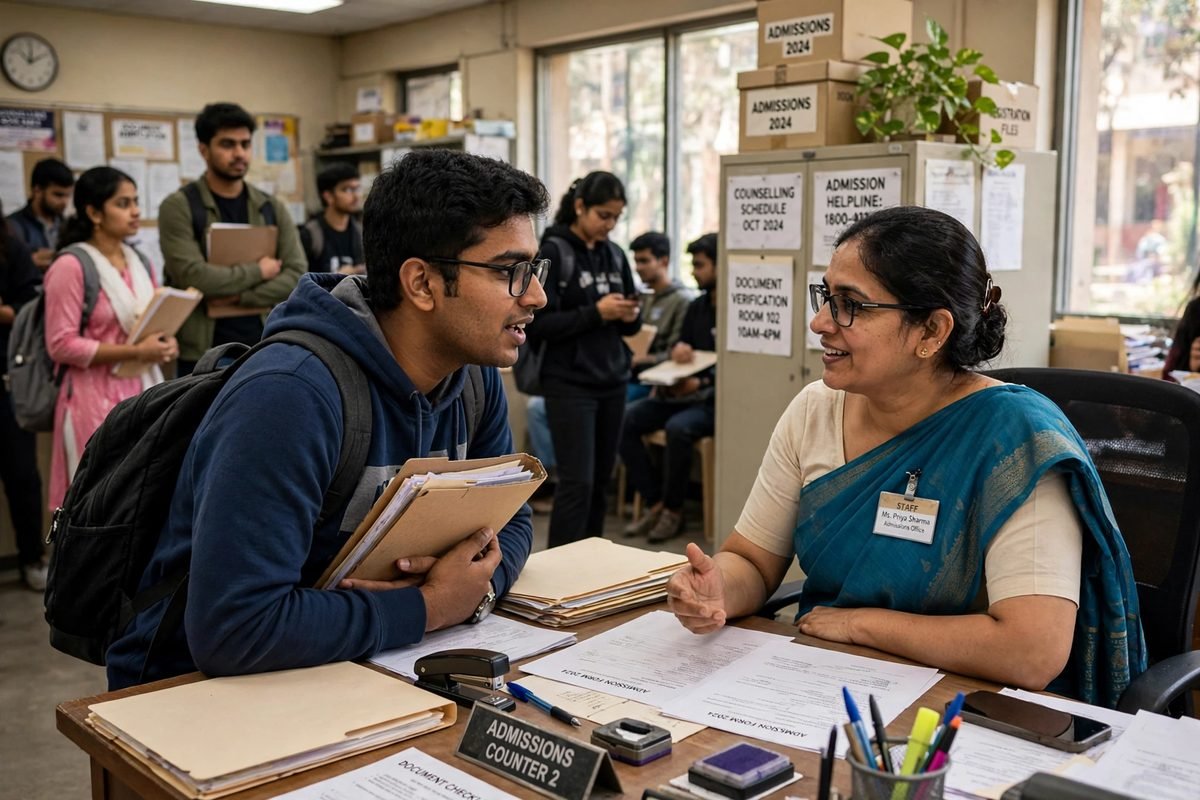
Institute pending. The application is waiting at the student’s own college or institution. This is where verification starts in every source’s account of the process: the institute checks admission and enrolment, the documents submitted, and the fee receipt, and confirms them before the application moves on. An application can stay pending at the institute for a long time if the institute has not yet verified it — and that, secondary sources say, is the most common reason a status appears stuck. The student-side action, in principle, is to ask the institute scholarship coordinator or nodal officer whether admission and documents are verified, and to supply any missing fee receipt or admission proof.
District or divisional pending. The application has passed the institute and is waiting at the district or divisional authority. This stage is administrative: the district officer checks the application against the scheme’s conditions and forwards it for final approval and sanction. A student generally cannot speed this stage up from the college, and the sources do not describe a student action at this stage beyond waiting and, if the wait is very long, asking the institute whether the application was forwarded. No officer’s name, number or office address is given in this article — none is verified.
Do not assume a pending status means the application is at one stage or the other. The portal’s own wording — “Pending at Institute” versus “Pending at District Officer”, where those labels are shown — is the only reliable indicator, and the labels vary across sources. If the portal shows no stage label, only “Verification Pending”, there is no verified way to tell which office holds the application except by asking the institute.
The checks a student can do, in principle
These are checks, not portal steps. They are what secondary sources agree a student can usefully do while waiting.
- Confirm the application was actually submitted. A submitted application shows a confirmation or acknowledgement; an application that was never submitted successfully will not appear in the status at all. Our status-meanings glossary explains the “Submitted” label.
- Ask the institute scholarship coordinator whether admission and documents are verified. This is the first and most useful check, because verification starts at the institute. Go in person if possible, and carry the fee receipt and admission proof.
- Check the documents against the common set: Aadhaar, caste or community certificate, income certificate, previous year’s marksheet, bonafide or enrolment certificate, and an Aadhaar-seeded bank account. Our central documents checklist lists what students are generally asked for. A missing or expired certificate is one of the common reasons secondary sources give for a verification delay — but whether a particular document is the cause in your case can only be confirmed by the institute or by the remark on the status page.
- Check the remark on the status page, if one is shown. A remark names the specific problem; a status with no remark and no change usually means the application is simply waiting in a queue.
- Check that the bank account is in the student’s own name and Aadhaar-seeded, because a bank or NPCI problem can hold up the later payment stage even after verification passes. Our NPCI status article explains the check in principle.
What not to do: do not submit a second, duplicate application while the first is pending — secondary sources list duplicate profiles as a reason for rejection. Do not pay anyone who promises to move your application forward. No fee is part of any verified MPTAAS procedure on this site.
What verification pending does NOT mean
It does not mean the application is rejected. Secondary sources are explicit on this point: do not assume pending means rejected. It does not mean the student did something wrong. It does not mean the scholarship will not come. It means the application has not yet been reached or cleared by the office holding it. It also does not mean the application will be verified by any particular date — no timeline is verified for 2026-27, and the timelines secondary sites quote conflict with each other.
Escalation, in principle: institute first, then district
If the status has not changed for a long time, the escalation order secondary sources describe is: institute first, then district. Ask the institute scholarship coordinator whether the application was verified and forwarded. Only if the institute confirms it was forwarded and the status still shows pending should the student consider the district Tribal Welfare office — and no officer’s name, number or address is given here, because none is verified. Do not skip the institute step: the district cannot verify an application the institute has not yet cleared, and asking the district first wastes the visit. The district-verification stage itself is covered in more detail in our follow-on article on district and divisional verification, which explains the stage in principle without giving portal steps or timelines.
How long is too long?
There is no verified answer for 2026-27. Secondary sources quote 15–30 days, 2–4 weeks, October to February, and “during the application window” — and those cannot all be right for the same application. The honest answer is that the wait depends on when the institute verifies, when the district clears the queue, and when the session’s verification window closes, none of which is published for 2026-27. If the application was submitted early and the status has not moved at all, the institute check in step 2 above is the useful action — not a calendar calculation. If the institute says the application was forwarded and the status still shows pending after that, the application is in the district queue, and there is no verified student action beyond waiting and re-checking.
FAQs
My status has said “Verification Pending” for weeks. Is my application rejected?
No — pending does not mean rejected. It means the application is waiting for verification, usually at the institute first. Ask the institute scholarship coordinator whether admission and documents are verified.
Should I go to the district office if my status is pending?
Not first. Verification starts at the institute. Ask the institute whether the application was verified and forwarded. Only then consider the district office, and no officer contact is given here because none is verified.
Can I do anything to speed up verification?
In principle, only the institute-side checks: confirm the application was submitted, ask the coordinator whether documents are verified, and supply any missing fee receipt or admission proof. There is no verified way to speed up the district stage.
How long does verification take?
No verified timeline exists for 2026-27. Secondary sources quote 15–30 days, 2–4 weeks and October–February, and they conflict. This article states no timeline as fact.
Will a pending status affect my payment?
Verification must complete before sanction and payment, so a long pending status delays payment — but it does not cancel it. Once verification passes, the stages are sanction, then payment processed, then credit, each covered in our payment guides.

1 thought on “MPTAAS Verification Pending — Why & What to Do”