Unofficial student guide. Not the official portal and not the Government of India or the Government of Madhya Pradesh. This article lists the documents that central scholarship schemes commonly ask for, drawn from the central scheme guidelines published on this site. It is a preparation checklist, NOT a definitive list for any one scheme: every scheme has its own document list, and the list on the scheme’s own guidelines page is the one that counts. It gives no MP document list as fact — the MP fresh-application document list is a separate, gated topic — and no portal steps.
Source status — read this first
- Last checked: 18 November 2026 (morning, this run). The document set below is the core set that secondary sources and the central scheme guidelines agree on for central schemes (NSP-based schemes, central pre-matric and post-matric schemes for SC, ST and OBC students). It is framed as “commonly asked for”, not as a verified list for any single scheme.
- Three cautions apply to the whole list: (1) a “50% marks in the previous exam” requirement is scheme-specific, not universal — it is not listed here as a general rule; (2) a domicile certificate is not required by every scheme — it is listed here as “where the scheme asks”; (3) upload and scan rules (file size, format, attestation) vary by scheme and by portal — this article gives no upload rules as fact.
- There is STILL no official MPTAAS 2026-27 announcement as of 18 November 2026: Buddy4Study’s MP Scholarship Portal page still states 2026-27 applications are “yet to be announced” and the MPTAAS last date “has not been officially announced”, and its MPTAAS page still says only “tentatively scheduled to open between November and December”. Nothing in this checklist is an MP 2026-27 requirement.
The short answer: seven documents cover almost every central scholarship application
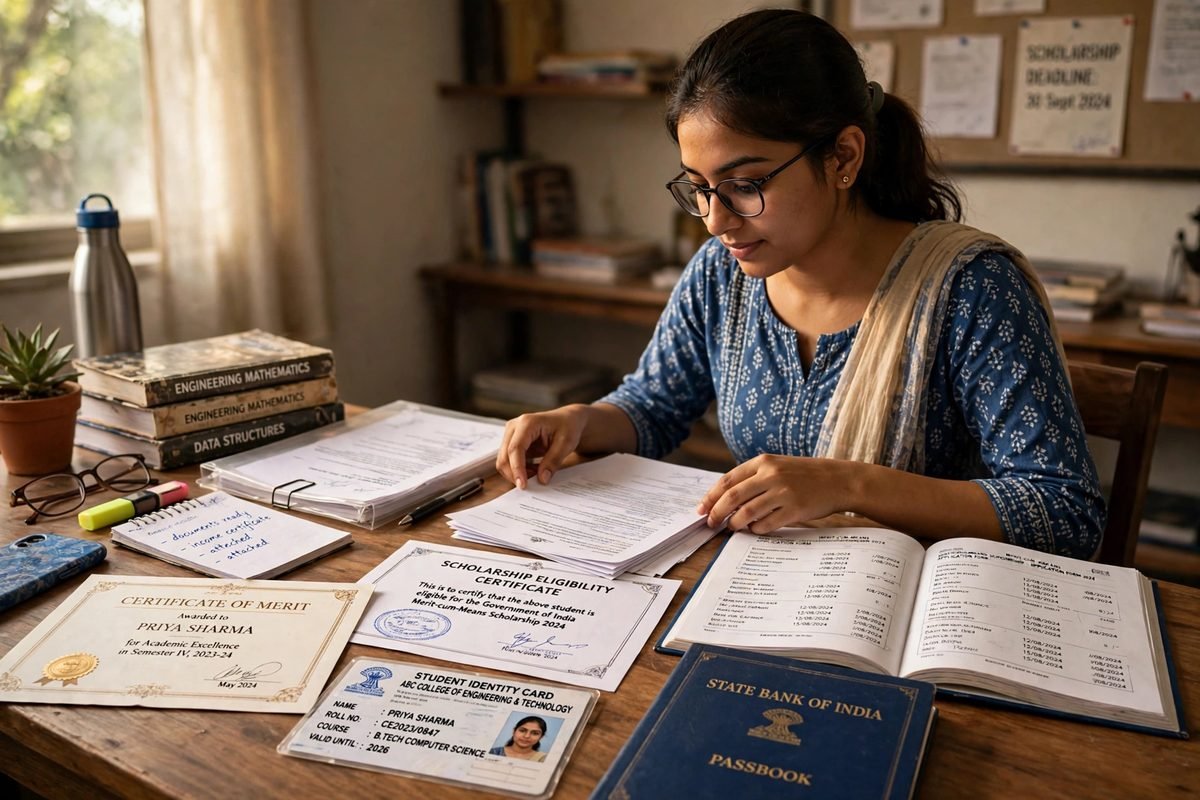
For most central scholarship applications — the ones filed through the National Scholarship Portal — the same core set comes up again and again: (1) Aadhaar card, (2) caste or community certificate, (3) income certificate, (4) previous year’s marksheet, (5) bonafide or enrolment certificate from the institute, (6) bank passbook or bank account details for an Aadhaar-seeded account, and (7) a domicile certificate and a recent photograph where the scheme asks for them. Keep all seven ready before the application window opens, and check the scheme’s own guidelines for anything extra. The rest of this article explains each one — what it proves, what goes wrong with it most often, and what to check before you upload it.
1. Aadhaar card
- What it proves: identity, and — through Aadhaar seeding — that the bank account can receive DBT payments.
- What goes wrong: the name or date of birth on Aadhaar does not match the marksheet or the bank account. A mismatch is one of the most common reasons an application stalls at verification.
- What to check: the spelling of your name and your date of birth on Aadhaar match your school records exactly. If they do not, correct Aadhaar first — do not apply with mismatched details and hope verification overlooks it.
- OTR on NSP is built around Aadhaar: what OTR is and which schemes it covers is explained here: https://storiesifyhub.com/nsp-otr-explained/
2. Caste or community certificate
- What it proves: that the student belongs to the category the scheme is for — SC, ST, OBC, EBC or DNT, depending on the scheme.
- What goes wrong: the certificate is in a parent’s name rather than the student’s, or it was issued by an authority the scheme does not accept, or the category on the certificate does not match the category entered in the application.
- What to check: the certificate is in the student’s name, the category is stated clearly, and it was issued by the authority the scheme’s guidelines name. Keep the original safe and a clear scan ready.
- Central schemes use different category rules: SC pre-matric (https://storiesifyhub.com/central-sc-pre-matric-scholarship/), ST pre-matric (https://storiesifyhub.com/central-st-pre-matric-scholarship/) and OBC pre-matric (https://storiesifyhub.com/central-obc-pre-matric-scholarship/) each define their own eligible categories.
3. Income certificate
- What it proves: that the family’s annual income from all sources is within the scheme’s limit — Rs 2.50 lakh per year for the central SC, ST and OBC pre-matric schemes, for example.
- What goes wrong: the certificate is expired, or it states income for the wrong year, or it was issued by an authority the scheme does not accept. Income certificates have a validity period — an old one is not accepted.
- What to check: the certificate is current, the income figure is for the year the scheme asks for, and the issuing authority is the one the guidelines name. Do not guess the income figure — it must match the certificate.
- Why the limit matters: the central schemes’ income limits are explained in the income-limit article, which also shows why MP figures differ and conflict: https://storiesifyhub.com/mptaas-scholarship-income-limit/
4. Previous year’s marksheet
- What it proves: that the student passed the previous class or year, and the marks obtained.
- What goes wrong: the marksheet uploaded is for the wrong year, or it is a provisional printout where the scheme asks for the board or university marksheet, or the name on it does not match Aadhaar.
- What to check: the marksheet is for the immediately previous academic year, the name matches Aadhaar, and the document is legible when scanned.
- Note: a minimum-marks requirement (for example, a “50% in the previous exam” rule) is scheme-specific, not universal. This article states no such rule as general — check the scheme’s own guidelines.
5. Bonafide or enrolment certificate
- What it proves: that the student is currently enrolled in the stated course at the stated institute.
- What goes wrong: the certificate is from the previous year, or it names a different course, or it is issued after the application is submitted and therefore does not match the application.
- What to check: get a fresh bonafide certificate for the current academic year, naming the current course and class, before the window opens. The institute is also the body that verifies the application — so the certificate and the institute’s records must agree.
- How verification works in the typical cycle is explained here: https://storiesifyhub.com/mptaas-scholarship-timeline/
6. Bank passbook or bank account details
- What it proves: the account into which the scholarship will be paid by DBT.
- What goes wrong: the account is not Aadhaar-seeded, or it is dormant or closed, or it belongs to someone else, or the IFSC or account number is entered wrongly. A sanctioned payment cannot reach an account that is not Aadhaar-seeded — this is the single most common reason a sanctioned payment never arrives.
- What to check: the account is in the student’s name, it is active, it is seeded with Aadhaar on the NPCI mapper, and the account number and IFSC in the application match the passbook exactly. If the account is dormant, reactivate it before applying.
- How to check a payment in principle, and what “processed but not credited” means, is explained here: https://storiesifyhub.com/pfms-know-your-payment/
7. Domicile certificate and photograph — where the scheme asks
- Domicile certificate: proves the student is a resident of the state the scheme is for. It is NOT required by every scheme — central schemes implemented through states generally ask for it, but the requirement varies. Keep one ready if your scheme asks; do not assume every scheme needs it.
- Photograph: a recent passport-size photograph, where the scheme asks for one. Keep a clear, recent photo — not a cropped group photo, and not one from several years ago.
- Anything else the scheme asks: some schemes ask for a disability certificate, or a certificate of the parent’s occupation (for example, Component 2 of the central SC pre-matric scheme asks for an occupation certificate from the District Social Welfare Officer). Those are scheme-specific — check the guidelines.
Before you apply: the five-minute check
- Names match everywhere. The name on Aadhaar, the marksheet, the caste certificate, the income certificate and the bank account must all spell the student’s name the same way. A single-letter difference can stall verification.
- Nothing is expired. Income certificates and bonafide certificates have validity periods. Check the dates before the window opens, not on the last day.
- Scans are legible. A blurred scan is a rejected document. Scan at a readable resolution, check every page after scanning, and keep the originals safe.
- The bank account is Aadhaar-seeded and active. Check this before applying, not after the payment is sanctioned.
- The scheme’s own list is the final list. This checklist is the common core. The scheme’s guidelines page may ask for one more document — or may not ask for one listed here. Read the guidelines for the scheme you are actually applying to.
What this checklist is not
- It is NOT the MP document list. The document list for a fresh MPTAAS application is a separate topic and is gated — it is not published here as fact, because the MP 2026-27 requirements have not been officially announced.
- It is NOT a portal guide. It gives no steps for filling any form on any portal.
- It is NOT a substitute for the scheme guidelines. If this checklist and the scheme’s guidelines disagree, the guidelines are right.
- It is different from the common-mistakes checklist (published), which covers the errors that delay or reject applications: https://storiesifyhub.com/mptaas-common-mistakes/
Related guides on this site
- MPTAAS Common Mistakes That Delay or Reject Applications: Checklist: https://storiesifyhub.com/mptaas-common-mistakes/
- Central SC Pre-Matric Scholarship Explained: Classes IX–X, Benefits and Rules: https://storiesifyhub.com/central-sc-pre-matric-scholarship/
- Central ST Pre-Matric Scholarship Explained: Classes IX–X, Benefits and Rules: https://storiesifyhub.com/central-st-pre-matric-scholarship/
- Central OBC Pre-Matric Scholarship Explained: PM YASASVI for Classes IX–X: https://storiesifyhub.com/central-obc-pre-matric-scholarship/
- NSP OTR Explained: One Time Registration for National Scholarship Portal Schemes Only: https://storiesifyhub.com/nsp-otr-explained/
- NSP Scholarships for MP Students: Schemes, Dates and How NSP Differs from MPTAAS: https://storiesifyhub.com/nsp-scholarships-for-mp-students/
- PFMS Know Your Payment: How Students Can Check a Scholarship Payment in Principle: https://storiesifyhub.com/pfms-know-your-payment/
- MPTAAS Scholarship: Complete Guide for Madhya Pradesh Students: https://storiesifyhub.com/mptaas-scholarship/
- MPTAAS Scholarship Timeline: From Application to Payment (Typical Cycle): https://storiesifyhub.com/mptaas-scholarship-timeline/
- Apply & Eligibility: https://storiesifyhub.com/application-eligibility/
- Home: https://storiesifyhub.com/
FAQs
Q: Which documents are needed for a scholarship application?
A: The core set most central schemes ask for is: Aadhaar card, caste or community certificate, income certificate, previous year’s marksheet, bonafide or enrolment certificate, bank passbook or account details for an Aadhaar-seeded account, and a domicile certificate and photograph where the scheme asks. The scheme’s own guidelines page is the final list.
Q: Is a domicile certificate required for every scholarship?
A: No. It is not required by every scheme. Central schemes implemented through states generally ask for it, but the requirement varies — check the scheme’s guidelines.
Q: Does every scholarship need 50% marks in the previous exam?
A: No. A minimum-marks rule is scheme-specific, not universal. This article states no such rule as general — check the scheme you are applying to.
Q: Why does my bank account need to be Aadhaar-seeded?
A: Because scholarship payments are made by Direct Benefit Transfer into the student’s bank account. A payment cannot reach an account that is not seeded with Aadhaar on the NPCI mapper. It is the most common reason a sanctioned payment never arrives.
Q: What if the name on my Aadhaar does not match my marksheet?
A: Correct it before applying. A name mismatch between documents is one of the most common reasons an application stalls at institute or district verification. Do not apply with mismatched details and hope it is overlooked.
Q: Is this the document list for MPTAAS?
A: No. This is a preparation checklist for central schemes. The MP fresh-application document list is a separate topic and is not published here as fact, because the MP 2026-27 requirements have not been officially announced.

4 thoughts on “Scholarship Documents Checklist: What to Keep Ready Before You Apply (Central Schemes)”